by Will Ross
---
Following The Iron Horse’s smash success, John Ford became a premiere director at Fox Film, one who could pull greater budgets, respect, and even pursue projects of his personal liking now and then. It’s easy to see that railroad saga as a moment of destiny, when Ford’s artistic domineering and hubris began their never-ending ascent, and that’s true to a point. But as the early 1920s turned to the late 1920s, he was still being assigned a glut of films by the studio, some of which he would receive a script for on the same day that shooting began. Still, it’s worth remembering that for all the reverence of Ford as an auteur who gained the prestige and control that his talents deserved, his filmography is peppered with “ones for them,” and many of those are now counted among his classics.
Between The Iron Horse and his next “major” project, 3 Bad Men, Ford directed six features in two years: Hearts of Oak, Lightnin’, Kentucky Pride, Thank You, The Fightin’ Heart, and The Shamrock Handicap. Half of these films are now lost, and of those that remain only The Shamrock Handicap was available to me in acceptable quality.
This was a stroke of great luck, for as the film’s title suggests, The Shamrock Handicap is the most Irish Ford film yet, and the first two reels, which are set in Ireland itself, represent his best cinematography to date, crammed with dynamic compositions lovingly sketching a romantic view of the country that was no doubt borne of the director’s nostalgia and personal enthusiasm. Cultural rituals, colourful supporting roles, horse racing, and a combative romance (“Rosaleen is too much horse for you to handle!” “You’re just jealous because you can’t!”) — shades of The Quiet Man abound.
by Will Ross
---
Fox, already reverent of Ford as one of their best directors, assigned him to direct a western treatment set among the construction of America's first transcontinental railway, and sent him on a location shoot uncommonly far from Los Angeles and the studio's influence.
Ford saw opportunity. Seven years earlier, he had used Universal's two-reel assignment of Straight Shooting to launch his feature career with a five-reel film. Now, the distance of the studio's hand allowed Ford to expand and improvise The Iron Horse into something like an epic.
"Something like" because, despite it's considerable sweep and two-and-a-half hour running time, The Iron Horse is far from the scale of, say, Birth of a Nation, or even Tumbleweeds. Ford's ever-increasing proficiency and sudden relevance — The Iron Horse was a massive hit — makes the film exciting both as a film and as a milestone in Ford's artistic development, albeit a problematic one.
The Iron Horse begins before the American civil war. David Brandon, a small-town surveyor and dreamer, strikes out with his son Davy to "reclaim that wilderness out there clean to California" by scouting a suitable route for a transcontinental railroad. They are waved off by fellow dreamer and soon-to-be president Abraham Lincoln, who himself sees the railroad as an inevitable path to the nation's glory.
Lincoln is a minor character of little importance to the story; he is a bookend, a historical myth, a symbol of progress and fortitude cast over the film. But this early scene predates his political importance and places him in a pre-war small town as a conspicuous arbiter of the future. Ford would continue to counterbalance Lincoln's historical myth against common-folk fictions in Prisoner of Shark Island, and then later against his recasting of that myth in Young Mr. Lincoln, and his appearance in The Iron Horse is the first surviving instance of the Lincoln character in a Ford film. It is also notable as a major early instance in Ford's handling of cultural history. Lincoln's role introduces a dynamic meshing of time and period; he has no significant role in the story because it is literally not his time. He is a ghost of his future self.
Such putting of hindsight to history is fundamental to the historical genre. Historical films are not actually about the period and events they purport to display; they are about the intervening history between that period and the film's creation. Effective period pieces understand that inherent anachronism and use it to their creative advantage, and it is vital that this quality be understood when approaching Ford's work.
In this case, that quality is leveraged to suit an imperialist intent. Intertitles in The Iron Horse frequently remind us that the onscreen toiling will lead to prosperity; the town of Cheyenne struggles now, but is “soon to become another Union Pacific metropolis." Not long after Lincoln’s first appearance, the narrative jumps forth to the civil war year of 1862, where the now-president pushes for the Pacific Railroad Act. He is again beset by doubters who ask that all resources be channeled to the war, to which Lincoln reiterates his vision for the country in peacetime. He is a seer of manifest destiny.
But as I said, Lincoln is present only to plant the film's ideological stake in the ground. Its hero is Davy, whose father is killed by a tribe of Indians who oppose any railroad. They are led by Peter Jesson, a white man in native disguise, who manipulates the Indians for political purposes. Just before he is murdered, the elder Brandon protests, "But you're a white man!"
The “white savage” was not an altogether uncommon villain in the western genre, and had perversely xenophobic politics. Such a character more easily permits the generic vision of native Americans as unsophisticated primitives; their threat to the white man’s invention and innovation, otherwise a mark of intelligence and power, is channeled only through the influence and organization of a white man, whose racial corruption makes a monstrous traitor of him. (See, for comparison, the Austin Stoneman character of Birth of a Nation, a film that Ford revered, as did most filmmakers of his time.)
Such an antagonist marks a clear display of Ford's undeveloped racial politics. Three decades later, Ford would take a decidedly more sympathetic view of miscegenation in The Searchers, most obviously in Martin Pawley’s mixed-race descent and Debbie Edward’s kidnapping. Perhaps we can even consider that film’s Comanche villain, Scar, as a reiteration of Jesson in a more morally complex context; that character has undergone substantial miscegenation willingly, and is played by a white actor, no less.
But the attitude towards the Indians is outright patriarchal; to characterize native opposition as shortsighted in light of the resultant displacement and natural devastation is hypocritical. Indeed, after the marauders have killed the older Brandon, and Davy has buried his father and weeps over his grave, nature has been devastated not by the white colonials, but by the Indians who deny their ambitions.
After Davy mourns his father’s murder (a moment of piss-poor performance by child actor Winston Miller that singlehandedly capsizes the scene’s chances of resonance), the film makes that jump forward to the Lincoln scenes of 1862, and then past the civil war and into the railroad’s arduous construction.
The film’s plot is pure generic fodder: Davy returns, an unrecognized Jesson plots the railroad's sabotage, and in time the former reveals and executes the latter. Ford handles this plot with his deftest mix of comedy, pathos, and action yet. However, the love plot with Davy and his reunited childhood crush Miriam Marsh (Madge Bellamy) are stolid and boring; perhaps Ford didn’t yet have the life experience to make innocent romance sparkle as he later would.
Otherwise, however, scenes of railroad towns and construction are lavishly detailed period reproductions, and feature consistently lovely imagery. As of this film, Ford had mastered his compositional style; subtly formed yet striking images that are both complex and evocative.
The near-final image of Davy standing over the finished tracks is an eloquent statement of pride and control, fully capturing the power and accomplishment of the railroad and the workers who made it, placing Davy ramrod straight as if he were the final spike in the rails, all against the vast landscape — as an adjacent title card puts it, “the buckle in the girdle of America.” It’s almost enough to make you forget the abuse and exploitation of labour that went into those tracks.
Scenes of work on the tracks recurrently show labourers singing the folk song “Drill, Ye Tarriers, Drill”, a classic instance of communal music in Ford, if a potentially anachronistic one — whether the song predated the Transcontinental Railroad is unclear. It is an unmistakably Fordian signature, reflective of both his Irish heritage and his precise choice of song. In Kathryn Kalinak’s book How the West Was Sung, Kalinak argues that these singing scenes, rhythmically edited and spliced with intertitles of the lyrics, forced the hand of any musicians accompanying the film, who could hardly contradict the song shown onscreen.(1) This diegetic insistence on particular songs permitted Ford greater control over how his film was scored. (He was by then no stranger to this technique; Bucking Broadway’s scene of weepy cowboys even shows the piano keys being played in close up.)
The film’s insistent optimism comes to a head in these scenes on the tracks, which preach tolerance and cooperation among races via assimilation: to help build the tracks as the Chinese did is valiant, to oppose them as the Indian antagonists do is ignorant and short-sighted. The vision of the railroad is the vision of the white man.
The film’s final tableau, which recreates the moment of A.J. Russell’s famous photograph of the Central Pacific engine “Jupiter” and Union Pacific No. 119, shows a meeting of more than tracks. By recreating the Russell composition and placing the photographer in the foreground, The Iron Horse indulges both the historical and modern point of view, and invites one to consider the greatness of the nation that developed during the interim. In due time, Ford’s optimism would dissipate, and his future works would show the country’s development in a state of flux.
Endnote
1. Kathryn Kalinak How the West Was Sung (University of California Press, 2007)
by Will Ross
---
It’s night. It’s pissing rain. A crippled man, Johnnie Hammond, is gripped by vengeful fury, and drags himself across the muddy village, teeth grit, hair flayed across his face. His father, John the heavy-set blacksmith, braves the storm and rescues the love interest Alice, who has attempted suicide after being framed for theft by her no-good beau Anson — just as Mary did in Just Pals, which gives an idea of the boilerplate material with which Ford worked at this stage in his career.
Johnnie, meanwhile, at last he reaches the home of Anson, crawls in the door, and demands a confession from Anson and his father for their betrayal. Then he gets the shit whipped out of him.
It would be unfair to judge or read much into Blacksmith, given that this reel constitutes only one eighth of its original runtime, but two things we can glean: first, that the acting is clearly laboured and overwrought (though, of course, it is a melodrama, and is perhaps improved by context); second, that Jack Ford’s high contrast handling of the stormy exteriors and overall direction, ridiculous though it is, is striking stuff.
For better or worse, Ford commits himself to the story’s hyperbolism with high-contrast cinematography, self-conscious compositions, and wild lighting effects. In some ways, this predicts Ford’s “Murnau period” in the late 20s, when the German expressionist was working at Fox.
The sequence concludes when John rescues his son from the whipping and forces the father-son fiends to confess their crimes publicly. The film ends with Johnnie’s legs repaired by his medically trained brother, and then a wedding between Johnny and Alice, with a far lighter tone.
Though the merits of the material and actors are dubious at best, Ford’s handling of the film is, at least in the remaining climax and denouement, a work of well-rounded competence with an artistic flair to it. The young director was clearly primed to dive into more personal projects, and when we next see him, he will no longer be Jack Ford.
by Will Ross
---
After four years at Universal cranking out dozens of shorts and even more features, Jack Ford was fed up with his employers (and his weekly salary of $300) and signed a long-term contract at another small studio called Fox Film. His salary was immediately doubled, his insane (though typical for the time) rate of production was slowed, and over the next three decades Ford would direct 50 films for the soon-to-be-powerhouse studio, including many of the masterpieces that would establish him as one of the world’s greatest auteurs.Admittedly, his debut for the studio, the serio-comic Just Pals, is a far cry from mastery, or even a really appealing whole. But there is some sense while watching it that perhaps Ford’s career turning point also marked an artistic one. And while that may only be because the glut of lost films renders any estimation of his work at Universal incomplete (though much of his early Fox films were lost too), or because this film is so much better preserved than any Ford film to date except maybe Bucking Broadway (courtesy of the astounding Ford at Fox DVD box set), it’s now clear that young Jack is well and truly on his way to the greatness of old John.
More than anything else, that has to do with his ever-greater tonal ambitions. Like Bucking Broadway, Just Pals shows Ford working in a comedy mode, but this time the broadness and rowdiness of gags has more spontaneity than the stagey mugging of his earlier film.
by Will Ross
---
It proved difficult to find a copy of A Gun Fightin’ Gentleman, and what I got my hands on could only be considered “watchable” in a circumstance of rabid completionism, i.e. this retrospective. But I delayed writing about it (and, out of guilt, delayed the entire blog) even further because even through the hazy, fragmented, poorly subtitled copy of the film I managed to get my hands on, the thing just doesn’t look like John Ford.In fact, it so little resembles Ford’s work that I tried to unearth evidence that he didn’t direct it; given the hurried and “loose” practices of Hollywood studios at the time, it didn’t seem totally out of the question. Alas, I could find no papers nor anecdotes to contradict Ford’s involvement and so I must begrudgingly accept this as one of his works and respond to it as such. I mean, his name’s right there on the goddamn poster.
In this permutation of Harry Carey’s Cheyenne Harry character, he is the owner of a large cattle ranch that has been seized through dishonest means by John Merritt, a wealthy land-grabber with a meat-packing business. After a fruitless campaign of letters to Meritt, Harry visits the meat baron for dinner. But Merritt is an asshole, and has only brought Harry to laugh at his poor manners — which, owing to his gentlemanly code of hospitality, never materialize.
And perhaps it’s this scene more than anything else that makes the thing so uncharacteristic of John Ford, even in his days as Jack Ford. Impersonal direction is one thing; saddled with dozens of short assignments a year, Ford surely had his share of quota-fillers amongst more personal films like The Last Outlaw.
But he was a man with great sympathy for the clash between old ways of life and modern economics. The battle between traditional communities and the darker shadows of capitalism and racism resonates throughout most all of Ford’s later works, overtly in some (e.g. The Grapes of Wrath, How Green Was My Valley), and as an undercurrent in many others. So it’s hard to swallow such a reduction of the conflict to a facile contrast, a petty “We’re not so different, you and I” narrative.
In the broader Ford catalogue, civilizations old and new are different, incommensurably so. And though some of the director's tropes are present in this scene — namely the decency of the man of the country and the hypocrisy of the social elite — they are hardly uncommon to the trappings of early western films.
by Will Ross
---
Permit me to indulge in one last fantasy of trading found films for lost ones: in order to see the missing second half of The Last Outlaw, I would happily trade The Indian Post entire, and maybe even a reel or two of Bucking Broadway. For the single remaining reel of The Last Outlaw, as damaged and faded as the copy I saw is, represents Jack Ford’s best extant pre-1920s work; it’s certainly the first to show him emerging as a Serious Artist.
No doubt this owes much to being the first surviving screen story that Ford co-wrote himself, a customarily Fordian plot that would in 1936 be remade into a feature, bearing a story credit for Ford and starring Harry Carey himself. But the tragedy of a long-lost former life is here embodied by Edgar “King Fisher” Jones as Bud Coburn, an outlaw of the old West just recently released from prison.
Bud returns to civilization and is confused by bustling automobiles, and civilian bustle. He melancholically daydreams of times past (notably, he sits by a blackened theatre entrance over which a superimposition of gun toting cowboys and dance hall girls appears), and goes about town looking for his daughter, whom he finds is the object of a local bootlegger’s affections.
The story does not fully take shape before the reel ends, but it’s clear that Ford was already interested in taking apart western legends and reducing them to tragic figures. The seeds of The Man Who Shot Liberty Valance are already sprouting here.
The film’s pathos largely comes simply from Bud making gestures and reactions that would be dangerous feats of badassery in his own time, but in his new context are merely the actions of a confused and antiquated own man. In one scene, a passing cyclist pretends to hold up Bud with his finger, and Bud draws his pistol instinctively. The cyclist does not even react, but calmly mounts his bike and rides away. Bud impotently holsters his weapon.
Equally sad is a moment when Bud passes a corner and sees a sheriff who had once been his old nemesis. He pokes his head around the corner, draws his pistol and aims it, before seeing his daughter walk up to the sheriff, have a brief, friendly exchange, and leave. Bud sits and looks pathetically at the pistol in his hand, resting in a composition that partitions the tired, hidden-away gunslinger from a society that no longer considers him a threat.
This is not to say that The Last Outlaw is anything like a major work; for every brilliant camera position there are many more that are merely functional, no doubt on account of the speed of its production (Ford made it in a year that saw him directing seven shorts and nine features). But it does mark a clear development in Ford’s artistic interests, as he gives his hero a compelling and complex inner life and consistently applies his thematic concerns throughout the picture.
Though there’s no getting around its incompletion, there is a poetry to how The Last Outlaw’s reel runs out that perfectly marks its place in Ford's filmography: Bud asks his daughter (who does not know him) if she knows where his father is. When she provides a not-entirely-accurate description of his crimes, he flies into a rage, throws an object in his hands against the bar, and yells “Don’t you know the difference between a horse and a cattle thief?”
That symbolic act of throwing an object would become a staple in Ford’s use of gestures, and Bud’s unintended revealing of his true self, an unflattering and unappealing convict who certainly doesn’t seem a welcoming father figure, is the act of a classic Ford hero, struggling to escape his history and find acceptance into a peaceful home. We’ve already seen one permutation of it in Straight Shooting, but this time his psyche’s boots have sunk far deeper into the mud.
In Jack Ford’s case, the loss of 1918’s The Craving, his sole directorial collaboration with his brother and erstwhile mentor Francis, particularly stings.
But for the purposes of this retrospective, a part of me is thankful that very little of Ford’s Universal output is available for viewing, for two reasons: the completionist in me balks at “greatest hits” retrospectives, whose omissions risk throwing out the baby with the bathwater; and it frees me up to view some of the fragments and shorts dotting Ford’s early work. And though at least parts of a few films from 1917 and 1918 have survived (including a complete print of the feature Hell Bent), the next available Ford I could get my hands on was By Indian Post, a partially restored two-reeler.
Sadly, viewing the film provided the final irony of the so-called silver lining to my completionism: I may have been spared from features that were probably barely above anonymous product, but based on this film his shorts were no better. In fact, By Indian Post is unrecognizable as Fordian not only when held up to Straight Shooting, but even next to the comparatively tossed-off Bucking Broadway. Only two shots even register as interesting: a savage closeup of the hero (Pete Morrison) being throttled...
...and a wide of cowboys in the foreground and background riding towards each other, whose fascination with horse rumps and horizon lines screams “John Ford!” louder than anything else in his work up to this point.
The story’s thinness is, thankfully, well-suited to a two-reeler: cowboy Jode McWilliams writes a love letter for a girl named Peg Owens. A passing native named Two Horns finds the letter, admires its “paper talk” and resolves to take it to a “white girl” (the second cringeworthy instance of racist comedy in the Ford canon) — obviously Peg. Jode sets out with a gaggle of cowboys to find Two Horns, who delivers the letter to Peg’s great delight.
A man who is apparently a rival for Peg’s love (the details of this are presumably lost with the still-missing 10 minutes) fights with Jode and ties him up in a hotel room, where he is rescued by a friend, grabs a parson in a neighbouring room, and is married to Peg as his rival tries to break down the locked door. The two are pronounced and ride away.
A little spotty in clarity, sure (there’s obviously a lot missing between those two paragraphs), but there’s a clear narrative there, marking a fine restoration job by Lobster Films. And though the thrill of watching a developing stylist doesn’t register much, it does at least show Ford achieving a more successful comic touch than Bucking Broadway, whose gags did not mesh much into the story as a whole. By Indian Post’s farce is fluid and pokes fun at its characters, and so it is, by and large, actually amusing.
But anonymous it remains, and I’ll take ambition over uninspired competence any day. It is valuable inasmuch as it bears the fingerprints of one of cinema’s supreme artists, but I can’t help but wish we could beseech the gods of film preservation to trade it for 4 Devils — or at least The Craving.
by Will Ross
---
Greatness rarely appears fully realized, and for every wunderkind debut feature, there are many more great artists who realized their craft through trial and error. Ford, by his own admission, had little natural talent for filmmaking, but was an enthusiastic learner. “The only thing I always had was eye for composition,” said Ford to Peter Bogdanovich, “and that's all I did have.” And though Fordianisms twinkle throughout Straight Shooting, my assessment that it has “a clear emotional flow” could rightly be seen as damning with faint praise, especially in light of the career still far down the horse trail.
Bucking Broadway was Ford’s last film of 1917, a year that had already seen him complete five shorts and three other features. Unlike Straight Shooting, it seems that Ford was very much finding his feet as a filmmaker at this point, particularly in the realm of comedy: Bucking Broadway is ultimately a shambling thrust towards the comic situation of its title, wherein a pack of cowboys ride down Broadway and start a brawl among wealthy New Yorkers.
Harry Carey, continuing his friendly collaboration with Ford and using once again the regular character name Cheyenne Harry, plays a ranch hand who falls in love with his boss’s daughter Helen (Molly Malone), whom he successfully propositions for marriage. That romance is shown here with a resolute lack of sophistication or charm, and given that it is central to the story, the lack of chemistry or other interest is a blight on the film as a whole.
What's more, their relationship's turns are tough to sympathize with: while Harry goes into town to buy some fine clothes, cattle-buying stud inspector Eugene Thornton (Vester Pegg) seduces Helen and convinces her to marry him in New York. While her father and Harry grieve their respective loss of daughter or fiancé, Helen sends Harry a souvenir he once gave her from New York. When Harry receives this, he springs into action and catches a train to the Big Apple.
Why he takes this gesture as an impetus to win Helen back is not entirely clear, at least not past generic impulses of romance. Carey, faced with awfully thin traces of characterization, can do little more than exude his natural charisma, but Malone’s performance impresses even less. Admittedly, she has a thankless role, and I do not shy from what may be an anachronistic response to movie romance in the nineteen-teens: she is a spineless, loathsome woman, and at the center of all that is wrong with the film on a narrative level.
It’s a very sloppy story, no doubt thanks to Ford’s merciless production rate at the time, and better suited to two or three reels than the five allotted. Much of that puffy running time is spent on comic scenes that simply aren’t very funny. The comedy is crassly staged; the best in John Ford humour is rooted in its characters and, even at its broadest, shows insight or nuance that is absent from the dragging gags here. One scene involving a group of ranch hands tapping at a piano and weeping at its melodies is an especially dull riff on genre conventions.
The worst of them features Carey himself: after buying his new duds, Carey leaves the store and sees a black man wearing clothes of the same make. Harry storms back into the store to throw his purchase back at the storeowner. The gag was well at home in its period of production, but it is nonetheless disturbing, and a reminder that Ford’s views on racism were not so sophisticated as they would later become — The Searchers was a long ways away yet.
Nevertheless, there are traces of the artist yet to come. Admittedly, the film is not even on the same pictoral plane as Straight Shooting, but there are nonetheless shots that command respect, showing sometimes ingenious composition and a still-improving grasp of mise en scene. One particular closeup is an absolute knockout: Thornton leaves Helen with a messily dressed woman named Glady, whom he has “introduced to her as his sister” but is obviously his mistress. As Glady and Helen sit in uneasy silence, the “sister” gives Helen a very nervous look, and as she does the shade of a nearby electric lamp — a fixture then absent from rural housing — casts streaking vertical shadows over her face. The shot foretells doubt and doom for the marriage with little more than a lighting conceit and a subtle, knockout bit part performance; it’s a shame that Gertrude Astor went uncredited for the role.
Broadway finishes with something more playfully typical of Ford: a comic fistfight. After Thornton gets drunk at a social occasion, he manhandles Helen, who thus realizes that maybe she would be better off with Harry after all (deplorable woman). Harry calls upon the comic relief ranchers, who just happen to be in New York, and a lengthy brawl between dozens of combatants ensues. Ford stages it mostly in long shots, where the action plays out on multiple vertical levels (stairs, a pillar, a pool, a balcony). It’s an entertaining piece of chaos, in no small part because all the fights at once look so real, and probably were: Ford had adopted the technique of paying actors to exchange real blows from his brother Francis, who would promise his cast “a dollar for a bloody nose and two for a black eye.”
Bucking Broadway is the last surviving feature Ford made for Universal under Laemlle, and given the speed with which he was given scripts to shoot at the time, it’s a wonder that he (or any other directors, for that matter) turned out any coherent work at all. But incoherence can be fertile ground for experimentation, and in Bucking Broadway it’s clear that Ford is playing around with comedy in ways that weren’t working just yet.
Bucking Broadway is available as an extra feature on Criterion's release of Stagecoach.
by Will Ross
---
After John Feeney’s lower-class childhood in a large family born to Irish emigré parents, he moved to California and joined his brother Francis (who had adopted the surname “Ford”) in the movie business. Francis was a highly ambitious and versatile artist (a director, musician, painter, and actor) with his own production company and considerable public esteem. John found much to admire in his 12-years-older brother as an artist; in a 1966 interview with Peter Bogdanovich he described Francis as “A great cameraman... a good director, Johnny of all trades, and master of all.”
He added that Francis was “the only influence I ever had, working in pictures.” This mentorship was essential to his formation not only in formal ideas and sensibilities, but also through the inferiority complex it engendered in Ford, who became wildly ambitious himself. As he became a critical member of Francis’s company, he developed a reputation for his stridency, and when Universal head Carl Laemmle made a director of Jack, Francis was glad to be rid of him. Laemmle’s supposed hiring words hint that Ford had already cemented his image as a tough, no-nonsense picture-maker that persists to this day: “Give Jack the job — he yells good.”
Jack Ford soon entered into a substantial collaboration with western star Harry Carey (25 films in four years), and after a few two-reel projects together, they turned one into a five-reeler without permission, resulting in Jack’s first feature-length project, 1917’s Straight Shooting.
By this time Ford was already an accomplished cameraman, and even in his first year as a director, his visual sensibilities are instantly apparent. The first image in the Ford feature canon is an iris shot that opens over three ranchers stacked on horseback in the foreground against a background field of grazing cattle. These ranchers have long held access to vast expanses of lands, but the arrival of settling farmers has shrunk their claims, disenfranchising rich barons like Thunder Flint. One farmer, Sweet Water Sims, is an object of particular ire for the ranchers; the old man, his daughter Joan, and his son Ted have resisted being driven out for years. Flint, who owns all sources of water near the Sims, warns them that anyone seen at a creek will be shot.
Thunder Flint has had enough, and hires outlaw Cheyenne Harry (Carey) to murder the old man. After Ted is shot at a creek by an anonymous gunman, Harry seeks the old man and finds his mark at his son’s grave, grieving with Joan and a sympathetic ranch man. Harry has a crisis of conscience, secedes from the ranching empire, and vows to protect the Sims.
This bad-to-good cowboy was a known trope of the time, and unlike the 1916 William S. Hart masterpiece Hell’s Hinges, Harry lacks the psychological depth to make his character truly compelling. But the film’s striking imagery, sure handed storytelling, and some exciting action sequences make it an auspicious start to Ford's extant career.
The fledgling genius's personal concerns are already clear in Straight Shooting. As always, he throws in his lot with the family, clearly supporting their values of unity, tolerance, and social progress. Those values are threatened by the older, more amoral America of outlaws and ruthless businessmen. This conflict would recur throughout Ford’s career, as would the outlaw-turned-hero’s struggle to redeem himself.
And though some scenes show a director leaning too heavily on his influences (the climactic siege on the family home is a contrived ripoff of the ride of the Ku Klux Klan in Birth of a Nation), others stake out a brilliance all their own. One scene wherein Joan, returning home from her brother’s burial, takes up his plate from the family table, holds it close, and solemnly places it in a drawer. This scene also takes clear cues from Griffith, but Ford adds another layer by intercutting it with Harry, who has just left Joan at the house, standing forlornly by his horse. When Joan closes the drawer, Harry mounts his horse and rides away through a gentle natural image. It’s both a tragic expression of mourning and of regret.
That moment anticipates the original ending, which had Harry refusing the victorious Sims’ offer to stay with them and live as one of the family. “Me a farmer? No. I belong on the range.” When Joan tries to stop him, he bids her farewell with a tender kiss on the forehead and sends her home, whereupon he gazes at the sunset. That version is now lost; for its 1925 rerelease (from which surviving prints derive), the dénouement was rearranged to place the final kiss on the forehead at the very end of the picture. It’s a brutish, mangled ending, made even clumsier by intertitles that insist the happy-ending narrative on shots to which they barely apply.
But prior to this moment, Straight Shooting’s imagery has had a clear emotional flow, and if we account for the ending as Ford intended it, it stands as an immediately distinctive debut: certainly because it is a melancholic western that extols the family unit, but also because Ford’s first hero was one to which he would return many times over; a victim of a changing moral plane who realizes that he cannot reconcile his past with a changing world.
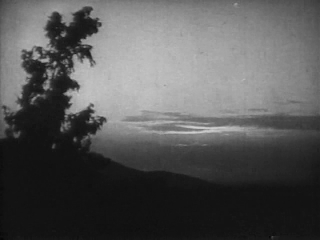
As to the intended closing image of the film, there is precious little evidence as to what it was. My best guess is a shot of a landscape silhouetted against a darkened sky, apparently at or near sunset. In the surviving cut it's merely used to establish dusk for the final scene of romantic union, but given that this scene takes place in broad daylight, it’s likely that Ford intended the foreboding, blackened shot to close the film. It functions well as the first Fordian close, dooming its reformed hero to wander an empty American landscape for his crimes.
About
-D. Scott & W. Ross
Labels
- 60s Stint (1)
- Devan's Posts (22)
- Diaries (5)
- Essays (1)
- Games (3)
- Guest Pieces (1)
- James Bond (2)
- John Ford (9)
- Man of Steel Week (4)
- Music (5)
- Politics (3)
- Reviews (104)
- Satire (1)
- We Three Heathens (2)
- Will's Posts (119)


.avi_snapshot_00.13.52_%5B2013.05.10_10.43.43%5D.jpg)
.avi_snapshot_00.18.09_%5B2013.05.27_16.56.39%5D.jpg)


